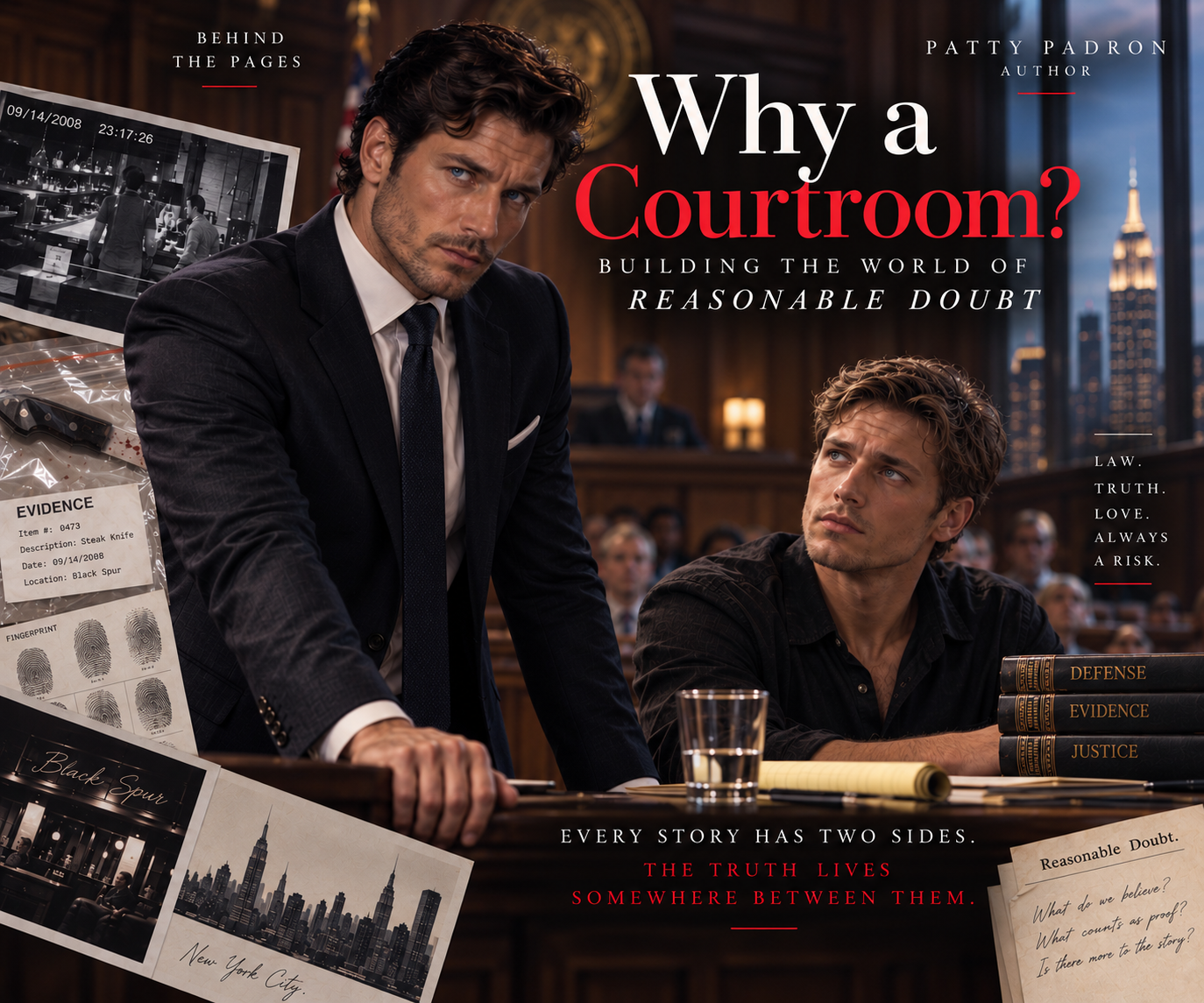
Casper Malak and Sean Lancaster in a New York courtroom surrounded by evidence from the murder case in Reasonable Doubt.
I could have given Casper and Sean an easier place to fall in love.
A coffee shop would have been considerably less complicated.
Instead, I gave them a murder charge.
When I began imagining Reasonable Doubt, I knew I didn’t simply want to write a romance with a legal subplot running alongside it. I wanted the case and the love story to ask the same questions.
What do we believe?
What counts as proof?
And what happens when the evidence seems to tell us one thing, but something inside us insists there is more to the story?
That’s what made a courtroom irresistible.
Because Reasonable Doubt was never only about whether Sean Lancaster committed murder.
It was also about two men learning to question everything they believed about themselves.
A Case That Looks Impossible
From the beginning, I wanted the evidence against Sean to be frighteningly convincing.
Not because there was one undeniable piece of evidence proving he was guilty, but because there were so many pieces that seemed to point in the same direction.
Sean was at the restaurant that night.
There was CCTV footage.
His fingerprints were on the steak knife identified as the murder weapon.
A witness claimed to recognize his voice.
He had no convincing alibi.
And then there was Sean himself.
A criminal record. Bar fights. A temper. A history that made it remarkably easy for a prosecutor to stand in front of a jury and say:
Of course it was him.
That’s the kind of case I wanted Casper to inherit.
Because if Sean’s innocence were obvious, Casper wouldn’t have much to do.
And neither would the reader.
Evidence Isn’t the Same as Truth
One of the things I loved about constructing the case was taking evidence that sounded devastating and asking what else it might mean.
Sean’s fingerprints are on the knife.
Terrible.
Except Sean works in the restaurant.
He handles those knives.
He’s captured on CCTV.
Also terrible.
Except again—he works there.
He’s supposed to be there.
A witness heard his voice.
But how certain can someone really be about a voice they heard during a chaotic moment?
Piece by piece, the certainty begins to weaken.
The evidence hasn’t changed.
The way we understand it has.
And that became one of the central ideas of the novel for me.
Facts matter.
But human beings decide what those facts mean.
Casper’s Natural Habitat
If Sean enters the story in the worst possible environment for him—a locked interview room—then the courtroom is where Casper should be at his most comfortable.
This is a world he understands.
Rules.
Procedure.
Strategy.
Evidence.
Opposing arguments.
Casper can prepare for all of those things.
He knows how to take something the prosecution presents as certainty and find the weakness inside it. He knows when to press a witness and when to let silence do the work. He understands that sometimes the most important question isn’t whether something could have happened.
It’s whether anyone can prove that it did.
In court, doubt is useful.
Casper knows exactly what to do with it.
Outside the courtroom?
That’s another matter entirely.
The Case Beneath the Case
Somewhere along the way, I realized I was writing two trials.
There is the obvious one.
The State versus Sean Lancaster.
Did Sean commit murder?
Can the prosecution prove it?
Is there enough doubt to send him home?
But underneath that trial, another one is happening quietly between Casper and Sean.
Sean has already judged himself.
His past is the evidence.
The mistakes. The fights. Juvenile lockup. The things he’s done to survive. The people who left.
Sean has spent years accumulating evidence for a verdict he reached long before Casper ever met him:
I’m not worth saving.
Casper looks at exactly the same evidence and reaches a different conclusion.
That matters.
Because the first thing Casper ultimately has to convince Sean of isn’t that a jury might find him innocent.
It’s that Sean’s life is worth fighting for.
And Casper Is on Trial Too
Casper’s evidence looks very different.
From the outside, it points toward success.
The career.
The suits.
The Manhattan office.
The penthouse.
The extraordinary control.
But Casper knows there is evidence nobody else sees.
The man he used to be.
The lines he crossed.
The appetites he learned to fear.
The version of himself he has spent years making certain never takes control again.
Casper has reached his own private verdict:
If I remain in control, I will be safe.
Then Sean enters his life and begins challenging the evidence.
Not deliberately.
Simply by mattering.
Suddenly Casper has to consider a possibility far more frightening than anything a prosecutor could put in front of him.
Maybe control isn’t the same thing as peace.
“Not 100% Certain”
One of my favorite courtroom moments comes during the cross-examination of Mr. Campbell.
The prosecution needs certainty.
Casper needs something much smaller.
Doubt.
When the witness can no longer say with complete confidence that the voice he heard belonged to Sean, that tiny fracture matters.
Not 100% certain.
That’s all Casper needs.
I love that because it captures something essential about the story.
Lives can turn on the smallest opening.
A question.
A hesitation.
The possibility that what you’ve believed might not be entirely true.
Sometimes doubt is enough to change everything.
Why Reasonable Doubt?
The title came to mean more to me as the story developed.
Obviously, it belongs in the courtroom.
Reasonable doubt is the standard standing between Sean and a guilty verdict.
But the phrase began following Casper and Sean outside the courtroom too.
Both men arrive with convictions about themselves that feel absolute.
Sean believes he knows what he’s worth.
Casper believes he knows what will happen if he ever loosens his grip.
Then they meet.
And each man introduces doubt into the other’s certainty.
Maybe Sean isn’t the person his history says he is.
Maybe Casper doesn’t have to spend the rest of his life controlling every dangerous part of himself.
Maybe surviving isn’t the same thing as living.
Maybe being known doesn’t always end in being abandoned.
Maybe love isn’t evidence of weakness.
Maybe the verdict they’ve already handed themselves was wrong.
Beyond the Verdict
That’s ultimately why I put this love story in a courtroom.
I wanted a world obsessed with evidence to surround two men who desperately needed to reconsider the evidence of their own lives.
In court, reasonable doubt can save a man’s life.
Outside it, doubt can do something quieter.
It can make us question the stories we’ve been telling ourselves for years.
Maybe I’m not what happened to me.
Maybe my worst mistake isn’t the whole story.
Maybe I am worth saving.
Maybe someone could love me anyway.
For Sean and Casper, those questions ultimately become far more important than any verdict.
And perhaps that’s what Reasonable Doubt has always been about.
Not simply learning to doubt what appears to be true.
But finding the courage to doubt the things we’ve been absolutely certain were true about ourselves.
— Patty
